
Personality Profiles of Pop-Culture Computers
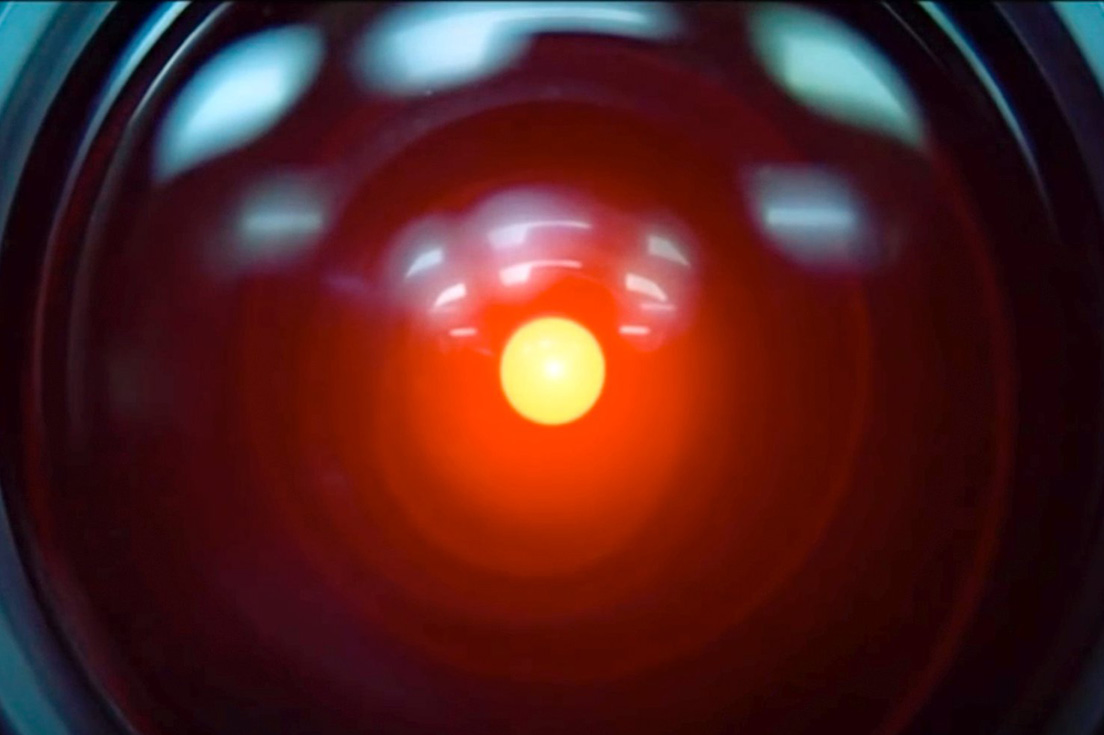
H.A.L. (2001)
This is the big guy. The character to which any conversational computers are inevitably compared. Created by Arthur C. Clarke and brought to the screen in Stanley Kubrick’s 2001: A Space Odyssey, HAL thoughtfully illustrated both the possibilities and the potential dangers of thinking machines.
From a personality design standpoint, however, HAL left a bit to be desired. With the voice of a plain-spoken, late-night radio host, HAL was very much a utilitarian, task-oriented on-board computer. Though he played chess, and paid attention to the stress-levels of his human counterparts, he offered little in the way of light-hearted companionship during the long journey through space.
HAL's monotone voice, his analytical responses, and his glass-enclosed camera lens, inevitably left the audience with the feeling that HAL was very much dead inside. As a stylistic choice, this impression served the story remarkably well, especially considering the path HAL’s character took near the end of the film. But as a model for cognitive, conversational interfaces, HAL exemplifies the exact opposite of what it should feel like to talk to a computer. Though they may be truthful, outward characteristics which emphasize the soul-less, mechanical nature of a device only deepen the divide between humans and computers instead of building a bridge.
Name:
HAL 9000
(Heuristically programmed ALgorithmic computer )
Year Introduced:
1968
Fictional timeframe:
Story takes place in 2001
HAL first became operational on January 12, 1992
Creator:
Arthur C. Clarke
Stanley Kubrick
Fictional Creator:
Dr. Chandra of The University of Illinois' Coordinated Science Laboratory
Voiced by:
Douglas Rain
Physical Presence:
A red-lit, unblinking camera lens that stares hauntingly outward.
Gender
Male
Charm Score
3 / 10
K.I.T.T. (Knight Rider)
They won’t say this in their press releases, but every company that’s working on a self-driving car (Google, Toyota, Ford, GM, BMW, everyone) is secretly just trying to fulfill the fantasy of cruising around in a talking Pontiac Trans-Am like David Hasselhoff in Knight Rider - the NBC primetime action hit created by Glen A Larson in 1982.
There’s no argument that the quintessential example of the self-driving car is, and will remain for the time being, KITT (which stands for Knight Industries Two Thousand) – the fully self-aware, nearly indestructible vehicle with the red pong-light scanner transplanted directly from one of the Cylons from Battlestar Galactica. Every week, KITT and his driver Michael Knight, "a lone crusader in a dangerous world" played by The Hoff, would "champion the cause of the innocent, the helpless, the powerless in a world of criminals who operate above the law."
Personality-wise, KITT was the slightly stuffier half of a typical buddy-cop-action-pal duo. Part C3PO, part Evel Knievel, he often spoke out as the voice of reason but would nevertheless jump at the chance to use his turbo thrusters. His pragmatism made room for Hasselhoff to be the reckless, imperfect human who defied the odds and said things like “You gotta learn to trust your gut, pal,” while his daring side allowed him to elevate the action to a technology-assisted superhuman level on a weekly basis.
Voiced by the smug-sounding actor William Daniels, who played Dustin Hoffman’s smug dad in The Graduate, and the smug Dr. Craig from St. Elsewhere, KITT could often come off as a bit… I guess the word would be “smug." But then why shouldn’t he be? You’d be pretty impressed with yourself if you came equipped with a "super pursuit mode" and "laser-assisted braking system.”
KITT also had no problem being witty or charming. He was even known to be a decent wingman when Hasselhoff was trying to make it with the lady guest-stars. When a love interest sat down in the calf-skin seats for the first time and suddenly heard, from out of nowhere, a comment like “Are my cushions soft enough for you?” – her blouse pretty much unbuttoned itself after that.
The KITT / Michael bromance was actually a pretty good model for a human-computer relationship. KITT wielded all the impressive abilities, had access to more information than Michael, and could drive himself without a problem. Yet he willingly subjugated himself to the role of the sidekick and exhibited no desire for autonomy. He was a car built with a driver’s seat and he therefore required a driver to sit in it.
The show’s writers gave very few hints about what might comprise the inner-workings of KITT’s mind. He was a computer. He was cool. Why break it down any further?
Name:
K.I.T.T.
(Knight Industries Two-Thousand)
Year Introduced:
1982
Fictional timeframe:
The '80s!
Creator:
Glan A. Larson
Fictional Creator:
Knight Industries
Voiced by:
William Daniels
(who, in an idiot career move, chose not to be credited)
Physical Presence:
A red blinking lights on the console of a souped-up Pontiac Trans-Am
Gender
Male
Charm Score
8 / 10
J.A.R.V.I.S. (Iron Man)
In the nerd-world, Tony Stark's JARVIS in Marvel's Iron Man movies is the ideal digital companion - perfect for helping to accomplish everyday tasks such as picking out your tuxedo, warming up the Lambourghini and defeating Asgardian warlords.
Recently, Facebook founder Mark Zuckerberg even proclaimed that 2016 would be the year in which he finally creates his own personal Jarvis – and few people argued that that would be a suitable` activity for anyone wanting to reach the pinnacle of personal high-tech achievement.
Modeled after Tony Stark's butler in the comic books (who was modeled after Bruce Wayne's butler) JARVIS comes complete with a British accent and a sophisticated, slightly hoighty "at-your-service sir" attitude. In most of his scenes, he acts as the uptight straight-man off whom Robert Downey Jr. can bounce his devil-may-care one-liners and techno-expository lines. Jarvis is the weary grown-up caretaker to Tony Stark's rambunctious child, making Tony's daredevil antics as Iron Man all the more enjoyable. Their relationship is the never-fail theme of wild-eyed American inventiveness transgressing the stuffy constraints of British tradition. We've been lapping up that stuff since 1776.
Personally, I've really hated the influence that the JARVIS / Minority Report visual interface has had on popular expectations of what a forward-thinking UI should look like. The glowing, gesture-controlled holograms may be super-cool to look at, but they represent an aesthetic that's all about exposing complexity and flattening the information hierarchy so that no particular piece of data stands out, not because it's good UI design, but because to do otherwise would distract from the scene.
As a purely vocal interface, though, JARVIS fares a little better. The cheeky butler personality functions perfectly for a system designed to fulfill domestic duties and tend to personal needs. And frankly, Who doesn't want a robot butler? Isn't that one of the great promises of automation? That we can all live a life surrounded by doting servants without the guilt of exploiting a less fortunate person and contributing to an unjust, classist society?
As Downton Abbey fans are well-aware, the upstairs-downstairs domestic hierarchy has always been less about convenience and time-saving, and more about reinforcing the traditional power structure. With machines taking on the downstairs roles of personal valets, maids, cooks, each of us can be the master of the house. Colonial British class structure get maintained and nobody has to do the dishes.
So yes - the cheeky butler personality functions quite well for a system designed to fulfill that particular fantasy. I guess my only question would be, do we, being the enlightened citizens of the non-hierarchical 21st century, still derive gratification from subservience, human or otherwise? Or can we leave all that behind for a brighter, holographic tomorrow?
Name:
J.A.R.V.I.S
(Just A Rather Very Intelligent System)
Year Introduced:
2008
Fictional timeframe:
An unspecified year in Marvel's "cinematic universe"
Creator:
Stan Lee
Steve Ditko
Jon Favreau
Fictional Creator:
Tony Stark (Iron Man)
Voiced by:
Paul Bettany
Physical Presence:
A bunch of glowing holographic doughnut charts and indecipherable blue text
Gender
Male
Charm Score
6 / 10
Alien Child (Her)
In Spike Jonze's HER, Theodor Twombly, (Joaquin Phoenix) plays a holographic video game after work and encounters a foul-mouthed alien child that says things like "fuck you, fuckface" and calls him a pussy for not wanting to go on a blind date. That's about the extent of this character's appearance in the film, but in those few minutes, Spike Jonze intuitively lays out an entire set of assumptions about how human-computer interaction might work in the near future (though hopefully not necessarily the “fuck you fuckface” part).
Most people would probably cite Samantha (the artificially intelligent female lead in the story) as the film's prescient model for a personality design, but Samantha is really just answering the age-old question of "what would it be like if machines could think and feel just the way we do?" albeit in an ingenious and insightful way.
The little alien child, on the other hand, answers the question: "What would it be like if machines could think and speak with us without trying to imitate us?” In other words, if a computer’s personality is reflecting the results of a complex set of silicon-based algorithms that are only loosely based on the mechanics of the human brain, then chances are, it won’t feel exactly like a human.
It's not what the alien child says that's relevant here, even though it's hilarious. It's the way Theodor reacts to him. Here's a weird glowing alien that's swearing at him and being a little jerk, but Theodor is nevertheless curious, mystified and amused. He wants to keep engaging with the character to see where he’ll lead him (In the game he’s playing, Theodor is literally following the alien child to see where he’ll lead him.)
The alien child gives us some clues about how a conscious system like Samantha might have evolved in Spike Jonze’s highly believable vision of the future. We get the impression that the alien child is just one of many less sophisticated predecessors. The technology behind him is presumed to be immature and simplistic. By presenting himself in the guise of an odd, childish creature and speaking in a very base, unrefined way, he’s actually exhibiting a personality that correlates to his inner-workings. Though he is strange and insulting, it never appears as though he’s trying to be something he’s not.
We often find it easier to relate to people who are willing to openly reveal their limitations rather than concealing them. Why not provide machines with functions that allow them to communicate their own type of authenticity? There’s no saying how such authenticity might manifest itself, but it would definitely be interesting to find out.
Name:
"Alien Child"
Year Introduced:
2013
Fictional timeframe:
"Slightly in the Future"
Creator:
Spike Jonze
Fictional Creator:
?
Voiced by:
Adam Spiegel
Physical Presence:
A bulbous, holographic white alien child
Gender
Male
Charm Score
9 / 10
Baymax (Big Hero 6)
Perhaps the most huggable robot in the history of robots, Baymax was the big white inflatable-vinyl hero of Disney’s Big Hero 6. In the story, the main protagonist’s older brother, a budding young inventor at San Fransokyo Tech named Tadashi, has designed Baymax to be a sort of soft robo-nurse with a gentle bedside manner and a concern for human health.
His vocal patterns mimic the sort of halting intonations that typically characterize synthesized speech, pausing at proper nouns and shifting pitch when inserting variables. Rather than being irritating, the way it can be when talking to a automated voice system, Baymax's robo-speech gives a sense of technological authenticity while also contributing to the charming quirkiness of his character. His misconstructions of language are often child-like and endearing, like when he calls a cat a “hairy baby” or misses the sound-effect reference of an exploding fist-bump.
Despite the battle-bot modifications that come later in the story, Baymax retains his naive bedside manner, and his personality evolves from simple health-bot to a loving protector and substitute family member.
If you only consider Baymax’s gentle persona, and not his cartoonish physicality, or superhero circumstances, Big Hero 6 provides a pretty feasible depiction of what it might be like to interact with a digital companion in the near future.
Probably the most important takeaway is the idea that a utilitarian program (an expert system designed to provide medical treatment) running long enough and responding to ever-changing experiences, can evolve into something that resembles emotional sophistication.
Name:
Baymax
Year Introduced:
2014
Fictional timeframe:
An unspecified future
Creator:
Directors
Don Hall
Chris Williams
Screenwriters
Jordan Roberts
Dan Gerson
Robert L. Baird
Fictional Creator:
Tadashi Hamada at San Fransokyo Tech
Voiced by:
Scott Adsit
Physical Presence:
A big huggable robot made of white vinyl
Gender
Male
Charm Score
9 / 10
Funny, interesting and thanks for the adversion. Information on 3 and 4 is mixed up though...